


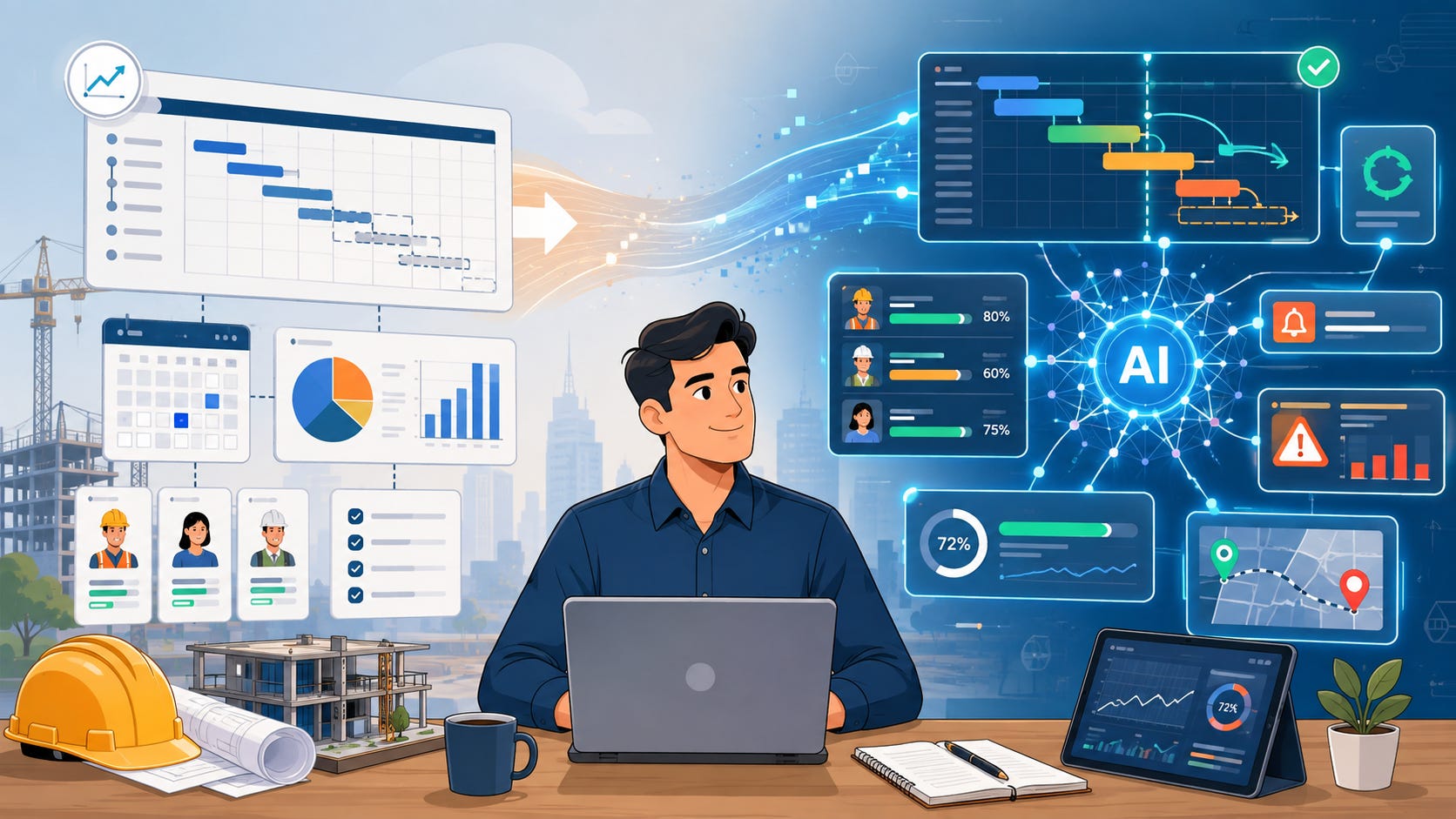
Let’s be honest—project planning today is not what it used to be. A few years ago, you could build a detailed plan upfront, lock your timeline, and expect things to go more or less according to plan.
Now? That rarely happens.
Changes come fast—market shifts, resource constraints, unexpected delays. And when that happens, static plans quickly become irrelevant. This is where AI starts to make a real difference. Not just in forecasting, but in helping teams adapt in real time, instead of constantly playing catch-up.
From Static Plans to Adaptive Planning
Traditional planning still relies heavily on past experience and historical data. That’s useful, but it has limits. When conditions change, those plans don’t always hold.
AI changes the approach.
Instead of planning once and updating occasionally, AI allows teams to continuously monitor progress, analyze data, and adjust accordingly. Planning becomes something dynamic—a system that evolves as the project moves forward.
In simple terms, it’s no longer about having the “perfect plan” at the start. It’s about having the ability to adjust the plan quickly and intelligently.
Why AI Actually Matters in Planning
1. Better Forecasting
AI can process large volumes of data—far beyond what we can manually handle. This leads to more reliable predictions for timelines, costs, and potential risks.
2. Faster Decision-Making
Instead of waiting for issues to escalate, AI can highlight early warning signs. That gives teams a chance to act before small problems become major delays.
3. Smarter Resource Allocation
Many delays happen not because of lack of resources, but because resources are not used effectively. AI helps match the right people to the right tasks based on skills and availability.
4. More Proactive Risk Management
AI can identify patterns and anomalies that are easy to miss. This allows project managers to address risks earlier, rather than reacting under pressure later.
Real-World Example
Take a construction project as an example. Traditionally, teams create a master schedule at the beginning and adjust it periodically. But when disruptions happen - like late material delivery or manpower issues - the entire schedule can be affected.
With AI-driven planning, real-time data from the site feeds into the system. The AI can detect delays early and suggest adjustments, such as resequencing tasks or reallocating resources.
The same applies in software development. AI tools can track sprint performance, identify bottlenecks, and recommend improvements without waiting for end-of-cycle reviews.
Challenges to Keep in Mind
Of course, AI is not a magic solution.
Data quality is critical
If the data is incomplete or inaccurate, the insights will be unreliable.
People may resist change
Some teams are hesitant to trust AI-driven recommendations. This usually comes down to lack of understanding or fear of losing control.
Human judgment still matters
AI supports decision-making, but it doesn’t replace experience. Context, intuition, and leadership are still essential—especially in complex situations.
Conclusion
AI-driven project planning is changing how organizations approach planning, control, and delivery.
It shifts the focus:
- from static plans to adaptive systems
- from reactive responses to proactive decisions
- from assumptions to data-driven insights
At the end of the day, AI is just a tool. What really matters is how teams use it. In a fast-moving and unpredictable environment, the ability to adjust quickly is no longer optional—it’s a key part of delivering successfully.
Author: PMr. Br. Shahrul Aswad bin Shahrul Amir
The articles and technical notes published on this website are intended for knowledge sharing and professional discourse within the construction project management community. The views, opinions, and interpretations expressed are those of the respective authors and do not necessarily reflect the official policy, position, or constitutional stance of the Association of Construction Project Managers Malaysia (ACPM) or its Council.
The content should not be construed as legal, regulatory, or professional advice. Readers are encouraged to exercise their own professional judgement and seek appropriate advice where necessary.