


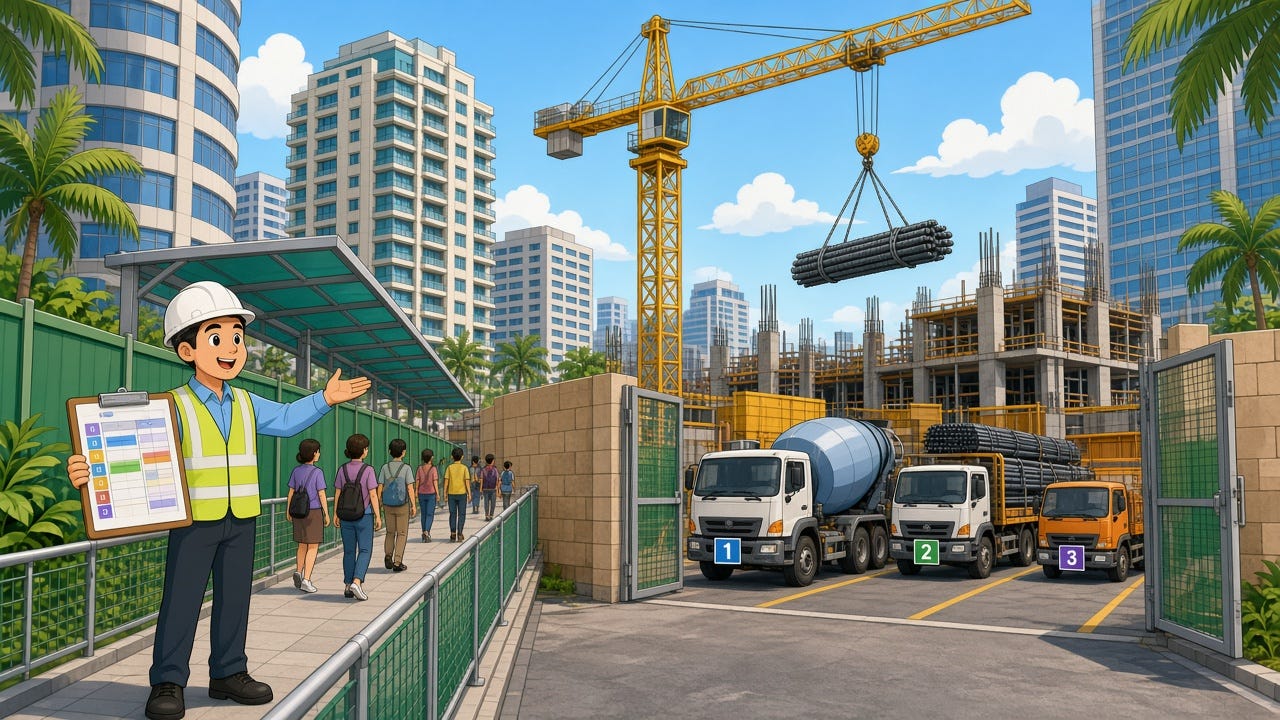
Picture a typical morning on a city-centre site in Kuala Lumpur, Penang or Johor Bahru. A concrete truck is waiting on the road shoulder because the pump has not finished setting up. A lorry carrying rebar has arrived an hour early and is blocking the only gate. The tower crane is booked for a formwork lift, but the curtain wall supplier also expects it this morning. Meanwhile, a traffic warden is asking who approved the lane closure, and the neighbouring shop owners are watching closely.
None of these problems is technically difficult. Yet together they can quietly cost a project hours every day, and weeks over its life. On constrained urban sites, logistics is not a side issue to be sorted out by the site team as they go. It is a core part of how the project is delivered, and it deserves the same planning discipline as the programme, the budget and the design.
Why logistics matters more on urban sites
On a greenfield site with open land around it, a contractor can usually find space for laydown areas, site offices, parking and material storage. Mistakes are absorbed by the space available. On an infill site in a dense urban area, that buffer disappears. The building footprint may cover almost the entire plot. Access may be limited to a single frontage on a busy road. Adjacent buildings, utilities, rail corridors and pedestrian walkways are often just metres away.
Malaysia’s major cities have seen steady growth in this kind of development: high-rise residential and mixed-use towers on small plots, redevelopment of older commercial areas, transit-oriented developments near rail stations, and hospital or institutional extensions that must be built while the existing facility keeps running. On all of these, the question of how things physically get onto and off the site becomes one of the biggest constraints on productivity.
Treat the logistics plan as a project document
The first step is simple: write a site logistics plan, and treat it as a controlled project document rather than an informal sketch. A good plan sets out, at minimum, the site boundary and hoarding line, gate locations and their use, vehicle routes to and from the site, crane positions and their coverage, hoists and material lifting points, laydown and storage areas, site accommodation, pedestrian routes for workers and the public, and waste collection points.
Crucially, the plan should be phased. A site at basement excavation looks nothing like the same site during superstructure works or during façade and fit-out. Space that is available early may be lost as the building rises, while new space may open up on completed podium slabs. Drawing the logistics layout for each major stage, and linking those stages to the programme, helps the team spot clashes months before they happen.
Internationally, this idea is well established. In London, Transport for London publishes guidance on Construction Logistics Plans, and many local planning authorities expect developers to submit one. The UK’s CLOCS standard (Construction Logistics and Community Safety) focuses on managing the road risk created by construction vehicles. Malaysian practice does not need to copy these frameworks, but they show what it looks like when logistics is treated as something to be planned and approved, not improvised.
Know the local approvals early
In Malaysia, many logistics activities depend on approvals from local authorities and other agencies. Hoarding on or near public land, temporary road or lane closures, the use of road reserves for loading, traffic management schemes, and works near utilities or rail corridors may all require separate permits, each with its own lead time and conditions. Requirements differ between city councils and municipal councils, and between states, so assumptions carried from a previous project in another city can be wrong.
Project managers should map these approvals at the planning stage and put them into the programme with realistic durations. A late road occupancy permit can hold up a crane erection or a major concrete pour just as surely as a late drawing. Lifting equipment such as tower cranes and passenger or goods hoists also brings statutory inspection and certification requirements under the occupational safety and health regime administered by DOSH (JKKP), and these steps need time in the programme too.
The tower crane is a shared resource
On most high-rise urban projects, the tower crane is the heart of the logistics system. Formwork, reinforcement, mechanical and electrical plant, façade panels and precast elements may all compete for the same hook. When crane time is allocated informally, the loudest trade often wins, and critical activities wait.
A better approach is to treat crane time as a scheduled resource. Many experienced contractors run a daily or weekly crane booking system, coordinated through the site team, where each trade requests lifts in advance and conflicts are resolved by the project’s priorities rather than by who arrives first. The same thinking applies to hoists, concrete pumps and loading bays. Where crane capacity is clearly the bottleneck, the team can consider options such as a second crane, a mobile crane for peak periods, a material hoist for lighter items, or changes to the construction method.
Deliveries need a timetable, not a hope
On a tight site, uncontrolled deliveries are one of the biggest sources of waste and risk. A lorry that arrives when there is no space to unload must either wait on the public road, circle the area, or be turned away. Each of these creates congestion, frustration with neighbours and lost time.
Delivery booking systems address this by giving each supplier a defined time slot and gate. Even a simple shared spreadsheet, managed by a logistics coordinator, can make a large difference. More advanced projects use online booking platforms linked to gate control. Whatever the tool, the principles are the same: book in advance, match deliveries to available crane and unloading capacity, avoid peak traffic hours where possible, and confirm the slot the day before.
Just-in-time delivery is attractive on sites with no storage space, but it depends on reliable suppliers and realistic travel times. In the Klang Valley and other congested areas, journey times can vary widely during the day, so it helps to build in some tolerance, for example an off-site holding area near the project where materials can wait before being called forward.
Waste and the public
Waste removal is the reverse flow that is often forgotten. Packaging, offcuts, excavated material and debris need a route off site, and on a tight plot waste bins compete for the same space as incoming materials. Planning waste collection points, chute locations and pickup times as part of the logistics plan keeps the site cleaner and safer, and supports any recycling or waste reduction targets the project has set.
Finally, there is the public. Pedestrians, motorists, nearby residents and businesses all experience the project mainly through its logistics: trucks, noise, dust, closures and access changes. Clear signage, protected walkways, sensible working hours and early communication about major operations such as large pours or crane erection can do much to keep goodwill.
Make someone own it
On many projects, logistics falls between roles. The planner owns the programme, the site manager owns the daily work, and safety staff own the safety plan, but nobody owns the flow of materials and vehicles as a whole. On larger or more constrained urban projects, appointing a dedicated logistics manager or coordinator, with authority over gates, crane booking and delivery schedules, can pay for itself quickly.
For clients and their project managers, the key is to ask about logistics early. At tender stage, a contractor’s outline logistics plan can reveal how well they understand the site. During pre-construction, the logistics plan should be reviewed alongside the programme and method statements. During construction, logistics performance, such as delivery reliability, crane utilisation and incidents on public roads, can be a regular item at progress meetings.
Conclusion
As Malaysian cities grow denser, more projects will be built on small, busy plots surrounded by people, roads and existing structures. On these sites, the difference between a smooth project and a frustrating one often comes down to logistics: whether the right material arrives at the right gate at the right time, whether the crane is lifting what matters most, and whether the public can live alongside the works. Treating logistics as a planned, owned and monitored part of delivery is a practical step every project manager can take. On a tight site, every delivery counts.
The articles and technical notes published on this website are intended for knowledge sharing and professional discourse within the construction project management community. The views, opinions, and interpretations expressed are those of the respective authors and do not necessarily reflect the official policy, position, or constitutional stance of the Association of Construction Project Managers Malaysia (ACPM) or its Council.
The content should not be construed as legal, regulatory, or professional advice. Readers are encouraged to exercise their own professional judgement and seek appropriate advice where necessary