


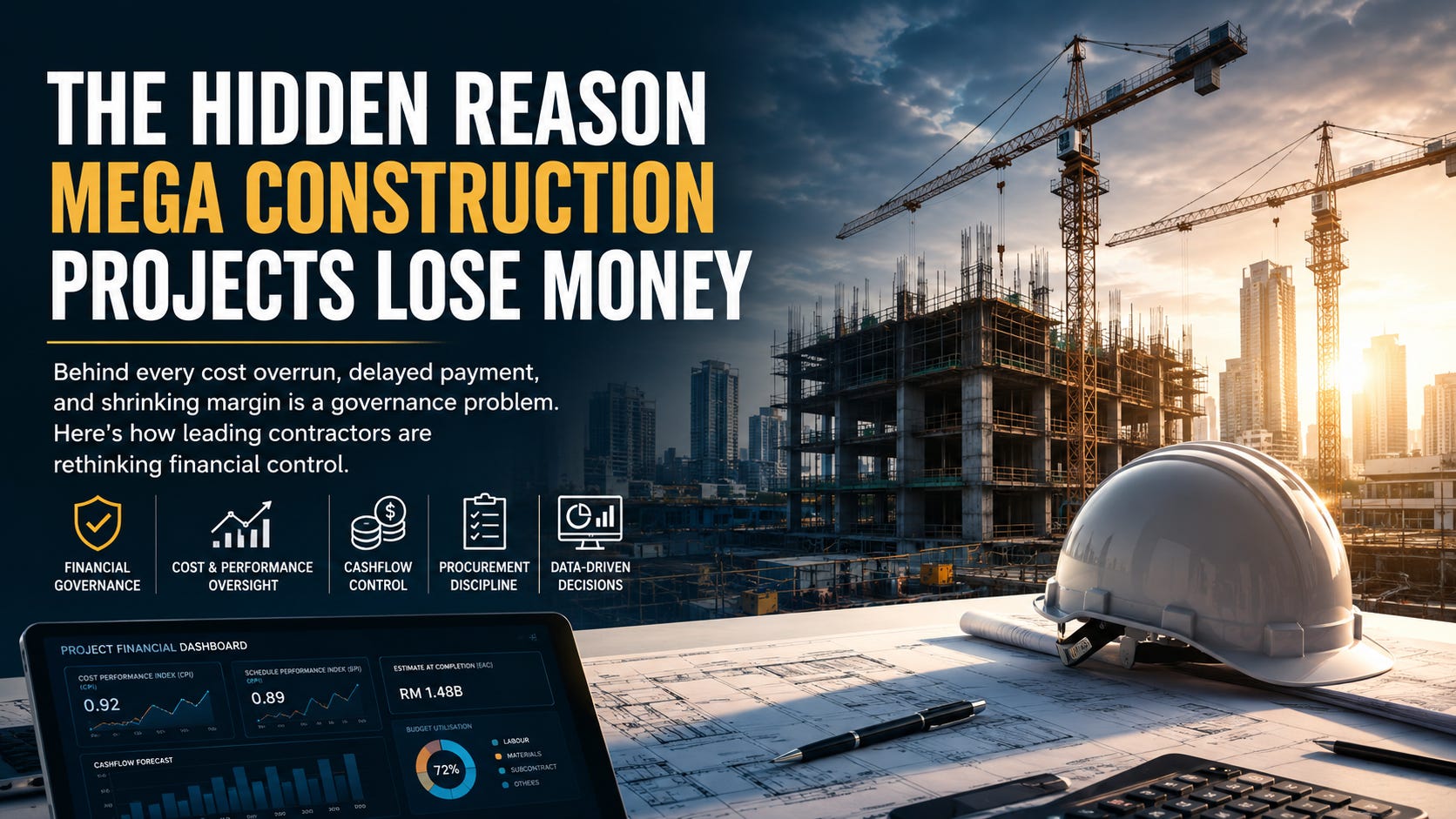
When a mega construction project runs into trouble, most people immediately look at the budget. Was the estimate wrong? Did material prices increase? Were there too many variation orders?
While these factors certainly matter, the real issue often goes deeper.
Many project failures are not caused by poor cost estimation alone—they are caused by weak financial governance.
Across the world, contractors continue to struggle with cost overruns, cashflow shortages, delayed payments, procurement issues, and shrinking profit margins. In many cases, the project team knows there is a problem, but the organisation lacks the governance structure needed to identify risks early and respond effectively.
For large-scale construction projects, financial governance is no longer a finance department responsibility. It has become a strategic capability that directly influences profitability, organisational sustainability, and stakeholder confidence.
The Hidden Financial Risks Behind Mega Projects
Mega projects are fundamentally different from ordinary construction projects.
They involve large capital commitments, long project durations, multiple stakeholders, complex contractual arrangements, and significant uncertainty. A single financial decision can have consequences worth millions of ringgit.
Some of the most common financial risks include:
Overly optimistic cost estimates
Excessive variation orders
Delayed client payments
Procurement irregularities
Retention-related cashflow challenges
Continued spending on underperforming project activities
The challenge is that many organisations only react after these issues become visible in monthly financial reports. By then, the damage is often already done.
What is needed is a governance system that identifies problems early and provides clear accountability for financial decisions.
Moving Beyond Traditional Cost Control
Most contractors are familiar with cost control.
Cost control focuses on monitoring budgets, tracking expenses, and comparing actual costs against planned costs.
Financial governance goes further.
It creates a structured framework that defines who can approve spending, how risks are escalated, how performance is monitored, and how financial decisions are made across the project lifecycle.
In simple terms:
Cost control asks, “How much have we spent?”
Financial governance asks, “Who approved it, why was it approved, and what impact will it have on project performance?”
That distinction is what separates reactive management from proactive leadership.
Delegation of Authority: The Foundation of Financial Discipline
One of the most overlooked aspects of project governance is the Delegation of Authority (DOA) framework.
Without clearly defined approval limits, projects can quickly lose financial discipline. Decisions are made inconsistently, approvals become informal, and accountability becomes blurred.
A strong DOA framework typically establishes approval thresholds across different levels of the organisation:
Project Managers handle routine operational expenditures.
Directors approve larger commercial commitments.
Boards or executive committees approve major financial decisions and strategic investments.
When implemented properly, a DOA framework reduces unauthorised spending and ensures that financial decisions receive the appropriate level of scrutiny.
Earned Value Management: Seeing Problems Before They Become Crises
One of the most powerful tools available to project leaders is Earned Value Management (EVM).
Unlike traditional reporting, EVM combines cost and schedule performance into a single management framework.
Key indicators include:
Cost Performance Index (CPI)
Schedule Performance Index (SPI)
Estimate at Completion (EAC)
Variance at Completion (VAC)
The value of EVM is not the numbers themselves. The value lies in the actions they trigger.
For example:
A CPI below 1.0 may trigger a detailed cost review.
An SPI below 1.0 may require a recovery plan.
Significant deviations from forecast completion costs may require executive intervention.
Instead of explaining why a project has failed, EVM helps organisations prevent failure before it happens.
Profit Doesn’t Matter If Cash Runs Out
One of the harsh realities of construction is that profitable companies can still fail.
Many contractors collapse not because they lack work, but because they run out of cash.
This is why cashflow governance deserves as much attention as profit reporting.
Project leaders should continuously monitor:
Billing cycles
Outstanding receivables
Retention balances
Subcontractor payment commitments
Utilisation of advance payments
A healthy project should not only show profit on paper—it should also generate positive cashflow throughout its lifecycle.
The two are not always the same.
Contingency Funds Should Be Governed, Not Consumed
Contingency budgets exist for a reason. They provide a financial buffer against uncertainty.
However, many organisations treat contingency funds as an emergency account that can be accessed whenever costs increase.
That approach defeats the purpose of contingency planning.
Effective contingency governance requires:
Risk-based allocation of contingency budgets
Formal approval processes before funds are released
Transparent tracking of utilisation
Periodic review of remaining risk exposure
When contingency is managed properly, it becomes a strategic risk management tool rather than a hidden reserve for inefficiencies.
Procurement: Where Governance Creates Immediate Value
Procurement is often one of the largest sources of financial risk in construction projects.
Poor procurement practices can lead to inflated costs, disputes, quality issues, and reputational damage.
Strong procurement governance should include:
Competitive tendering processes
Transparent evaluation criteria
Dual-approval mechanisms
Vendor performance monitoring
Conflict-of-interest declarations
These controls not only improve financial outcomes but also strengthen trust among clients, investors, regulators, and project stakeholders.
The Future Is Digital Financial Governance
Financial governance is becoming increasingly data-driven.
Modern construction organisations are moving away from static spreadsheets and monthly reports towards real-time visibility.
Digital governance platforms now enable:
Live cost dashboards
Automated performance tracking
Cashflow forecasting
Early warning alerts
Predictive financial analytics
When integrated with project management platforms such as Primavera and BIM-enabled systems, financial information becomes more accessible, transparent, and actionable.
Leaders no longer have to wait until the end of the month to discover a problem.
A Simple Roadmap for Construction Firms
For organisations looking to strengthen financial governance, transformation does not need to happen overnight.
A practical roadmap might include:
Phase 1: Establish a clear Delegation of Authority framework.
Phase 2: Introduce Earned Value Management reporting.
Phase 3: Develop integrated cashflow monitoring dashboards.
Phase 4: Formalise contingency governance procedures.
Phase 5: Implement digital financial reporting systems.
Phase 6: Introduce predictive analytics and AI-assisted forecasting.
For most mid-sized contractors, this journey can realistically be achieved within 12 to 24 months.
Final Thoughts
The construction industry often celebrates engineering excellence, technical innovation, and project delivery milestones. Yet some of the most successful projects are distinguished by something less visible: financial discipline.
Mega projects do not fail simply because costs increase.
They fail when organisations lack the governance systems needed to control those costs, manage risks, and make informed decisions.
Financial governance is no longer a compliance exercise or an accounting function. It is a leadership capability.
In an increasingly competitive construction environment, the firms that thrive will not necessarily be those with the best technical expertise. They will be the ones that combine technical excellence with strong financial governance.
Because in the end, successful projects are not measured only by what gets built—they are measured by how sustainably and profitably they are delivered.
The articles and technical notes published on this website are intended for knowledge sharing and professional discourse within the construction project management community. The views, opinions, and interpretations expressed are those of the respective authors and do not necessarily reflect the official policy, position, or constitutional stance of the Association of Construction Project Managers Malaysia (ACPM) or its Council.
The content should not be construed as legal, regulatory, or professional advice. Readers are encouraged to exercise their own professional judgement and seek appropriate advice where necessary