


Abstract
Governance in construction projects has historically been approached as a compliance-oriented administrative requirement. However, the increasing capital intensity, regulatory scrutiny, contractual complexity, and stakeholder accountability within contemporary infrastructure developments require governance to function as a strategic control architecture rather than a procedural formality. Within Malaysia’s regulatory environment—overseen by the Construction Industry Development Board, Board of Engineers Malaysia, and Malaysian Anti-Corruption Commission—construction governance must evolve toward integrated, predictive oversight.
This article proposes a structured three-tier governance framework comprising corporate, project, and operational governance layers. The framework integrates financial control mechanisms, risk governance principles aligned with ISO 31000, anti-corruption safeguards aligned with ISO 37001, and digital governance transformation pathways. The study argues that governance maturity significantly influences project outcomes, contractor sustainability, and institutional credibility. An implementation roadmap is presented for Malaysian construction organisations seeking systematic governance enhancement.
Keywords: project governance, construction management, financial governance, risk governance, Malaysia construction industry, CCPM
INTRODUCTION
Construction projects are inherently capital-intensive, risk-exposed, and contractually complex undertakings. Despite advancements in structured project management methodologies, cost overruns and schedule delays remain persistent global phenomena (Flyvbjerg, 2014). These recurring inefficiencies often stem not from technical incapacity but from deficiencies in governance structures.
In Malaysia, regulatory oversight by the Construction Industry Development Board (CIDB) and professional regulation by the Board of Engineers Malaysia (BEM) underscore the institutional necessity for structured governance frameworks. Additionally, enforcement under the Malaysian Anti-Corruption Commission reinforces the legal and ethical dimensions of construction governance.
Project governance differs conceptually from project management. While project management focuses on execution efficiency and delivery performance, governance establishes authority boundaries, accountability mechanisms, escalation protocols, and oversight controls (Müller & Lecoeuvre, 2014). Without governance architecture, projects may operate procedurally yet lack strategic direction and institutional discipline.
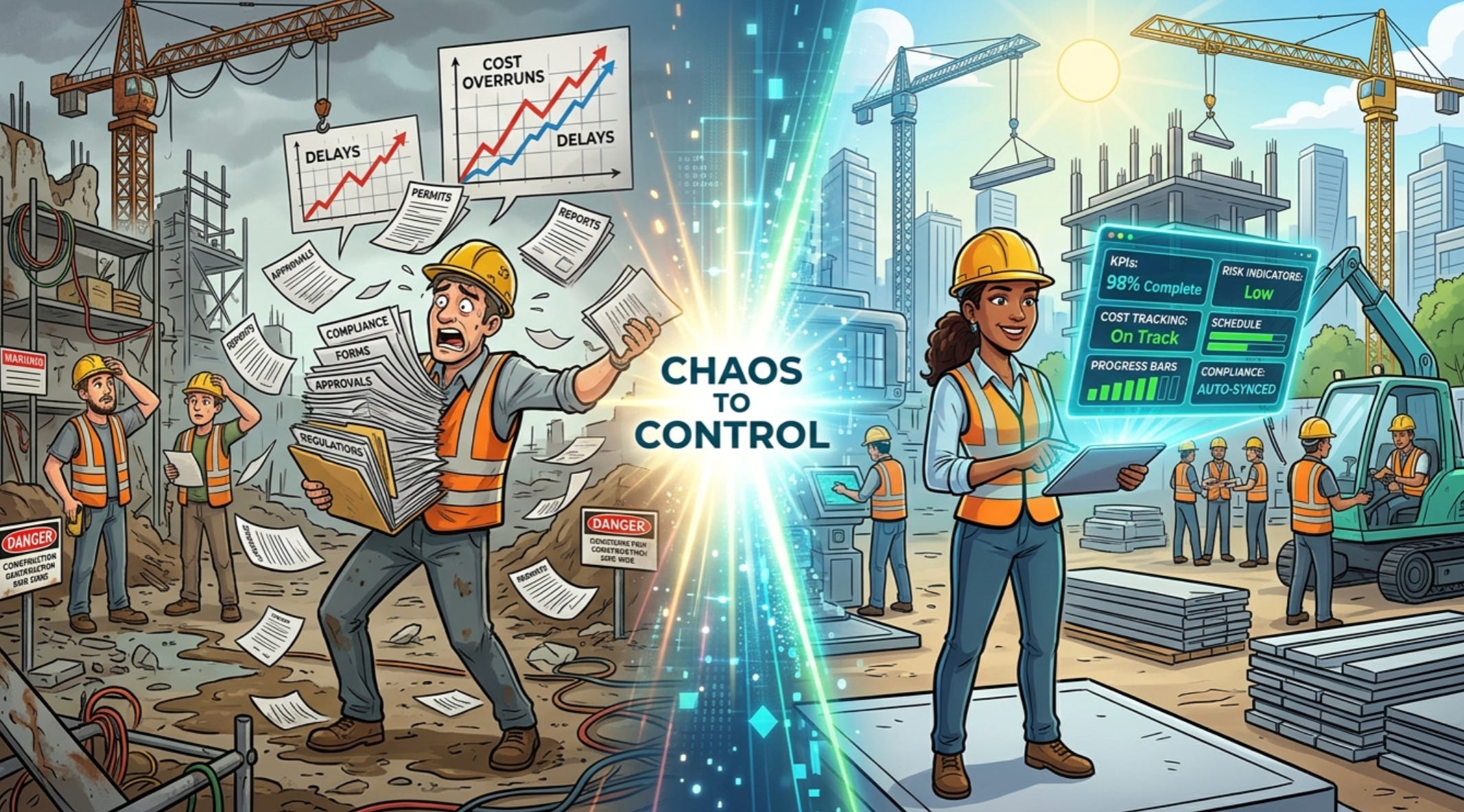
This article reframes governance as an integrated control system rather than a compliance checklist.
CONCEPTUAL FRAMEWORK OF PROJECT GOVERNANCE
Project governance is defined as a structured framework of authority, accountability, and oversight that ensures alignment between project objectives and organisational strategy (Organisation for Economic Co-operation and Development [OECD], 2015). Governance integrates multiple control dimensions, including:
Decision-right structures
Financial approval thresholds
Risk oversight mechanisms
Ethical enforcement systems
Regulatory compliance integration
Governance addresses structural risk exposure and safeguards institutional integrity. Unlike compliance, which ensures minimum legal adherence, governance ensures strategic alignment and long-term sustainability.
MALAYSIAN CONSTRUCTION GOVERNANCE CONTEXT
Malaysia’s construction industry operates within a layered regulatory ecosystem. Key institutions include:
Construction Industry Development Board – contractor registration and industry regulation
Board of Engineers Malaysia – regulation of engineering practice
Malaysian Anti-Corruption Commission – enforcement of anti-corruption legislation
Regulatory non-compliance may result in licence suspension, blacklisting, financial penalties, or criminal prosecution under the Malaysian Anti-Corruption Commission Act 2009.
However, regulatory compliance alone does not ensure strategic success. Governance mechanisms are necessary to integrate regulatory requirements into operational and financial control systems.
THREE-TIER GOVERNANCE ARCHITECTURE
CORPORATE GOVERNANCE
Corporate governance establishes the macro-level control environment. According to OECD (2015), boards are responsible for defining risk appetite, overseeing capital allocation, and safeguarding stakeholder interests.
Corporate governance functions include:
Capital expenditure approval
Risk tolerance definition
Ethical tone-setting
Establishment of steering committees
Corporate governance defines acceptable exposure limits and ensures alignment with organisational strategy.
PROJECT GOVERNANCE
Project governance translates corporate oversight into structured project-level control. One of the most effective mechanisms is the stage-gate system, which introduces formal review checkpoints at critical project milestones.
Stage-gate controls typically include:
Feasibility approval
Budget endorsement
Procurement award
Construction commencement
Completion and handover
These gates prevent escalation of commitment bias, whereby organisations continue investing in underperforming projects due to sunk-cost effects (Staw, 1981). Project steering committees oversee major variation approvals and performance variance management.
OPERATIONAL GOVERNANCE
Operational governance is exercised at the project execution level. Instruments include:
Earned Value Management (PMI, 2021)
Risk register monitoring aligned with ISO 31000 (International Organization for Standardization [ISO], 2018)
Non-conformance reporting systems
Health, Safety, and Environment (HSE) surveillance
Cashflow performance dashboards
Operational governance ensures daily adherence to financial, schedule, and risk boundaries defined at higher governance levels.
FINANCIAL GOVERNANCE MECHANISMS
DELEGATION OF AUTHORITY
Delegation of Authority (DOA) matrices define financial approval thresholds and prevent unauthorised expenditure. Internal control frameworks such as the Committee of Sponsoring Organizations of the Treadway Commission (COSO, 2013) emphasise structured approval hierarchies as foundational governance mechanisms.
A clearly defined DOA structure reduces procurement leakage, variation abuse, and cost escalation.
EARNED VALUE GOVERNANCE
Earned Value Management (EVM) integrates cost and schedule performance indicators such as Cost Performance Index (CPI) and Schedule Performance Index (SPI) (PMI, 2021). CPI and SPI thresholds provide early warning signals for corrective governance intervention.
EVM transforms governance from retrospective cost tracking to predictive financial control.
CASHFLOW OVERSIGHT
Liquidity risk remains a leading cause of contractor insolvency. Governance dashboards must monitor receivables aging, billing cycles, retention exposure, and subcontractor liabilities. Financial governance ensures that profitability is supported by sustainable cashflow management.
RISK GOVERNANCE INTEGRATION
Risk governance aligns with ISO 31000 (ISO, 2018), which prescribes systematic identification, assessment, treatment, and monitoring of risks.
Each risk entry should include:
Probability assessment
Impact evaluation
Exposure rating
Assigned mitigation owner
Risk governance transforms uncertainty into measurable and controllable exposure.
ETHICAL GOVERNANCE AND ANTI-CORRUPTION CONTROLS
The construction sector is globally recognised as vulnerable to corruption risk (Transparency International, 2011). Malaysian enforcement under the Malaysian Anti-Corruption Commission mandates structured anti-bribery controls.
Best practices aligned with ISO 37001 include:
Conflict-of-interest declarations
Vendor due diligence procedures
Whistleblower protection mechanisms
Transparent procurement processes
Ethical governance protects corporate reputation and long-term viability.
GOVERNANCE MATURITY MODEL
Governance maturity may be categorised into five progressive stages:
Ad hoc
Controlled
Structured
Integrated (digital dashboards)
Predictive (AI-enabled analytics)
Higher governance maturity correlates with improved predictability, enhanced institutional resilience, and sustainable profitability.
DIGITAL TRANSFORMATION OF GOVERNANCE
Emerging digital technologies enable predictive governance capabilities, including:
Artificial intelligence-driven risk analytics
Digital twin project monitoring
Blockchain-enabled contract traceability
Real-time key performance indicator dashboards
Digital governance reduces information asymmetry and enhances decision-making speed and transparency.
CONCLUSION
Governance in construction must evolve beyond compliance-driven administration to strategic control architecture. Within Malaysia’s regulated environment, governance maturity directly influences profitability, risk containment, institutional credibility, and long-term sustainability.
Project performance variance is frequently attributable not to engineering limitations but to governance robustness.
Institutional survival in contemporary construction markets depends upon structured, layered, and digitally integrated governance systems.
The articles and technical notes published on this website are intended for knowledge sharing and professional discourse within the construction project management community. The views, opinions, and interpretations expressed are those of the respective authors and do not necessarily reflect the official policy, position, or constitutional stance of the Association of Construction Project Managers Malaysia (ACPM) or its Council.
The content should not be construed as legal, regulatory, or professional advice. Readers are encouraged to exercise their own professional judgement and seek appropriate advice where necessary.