


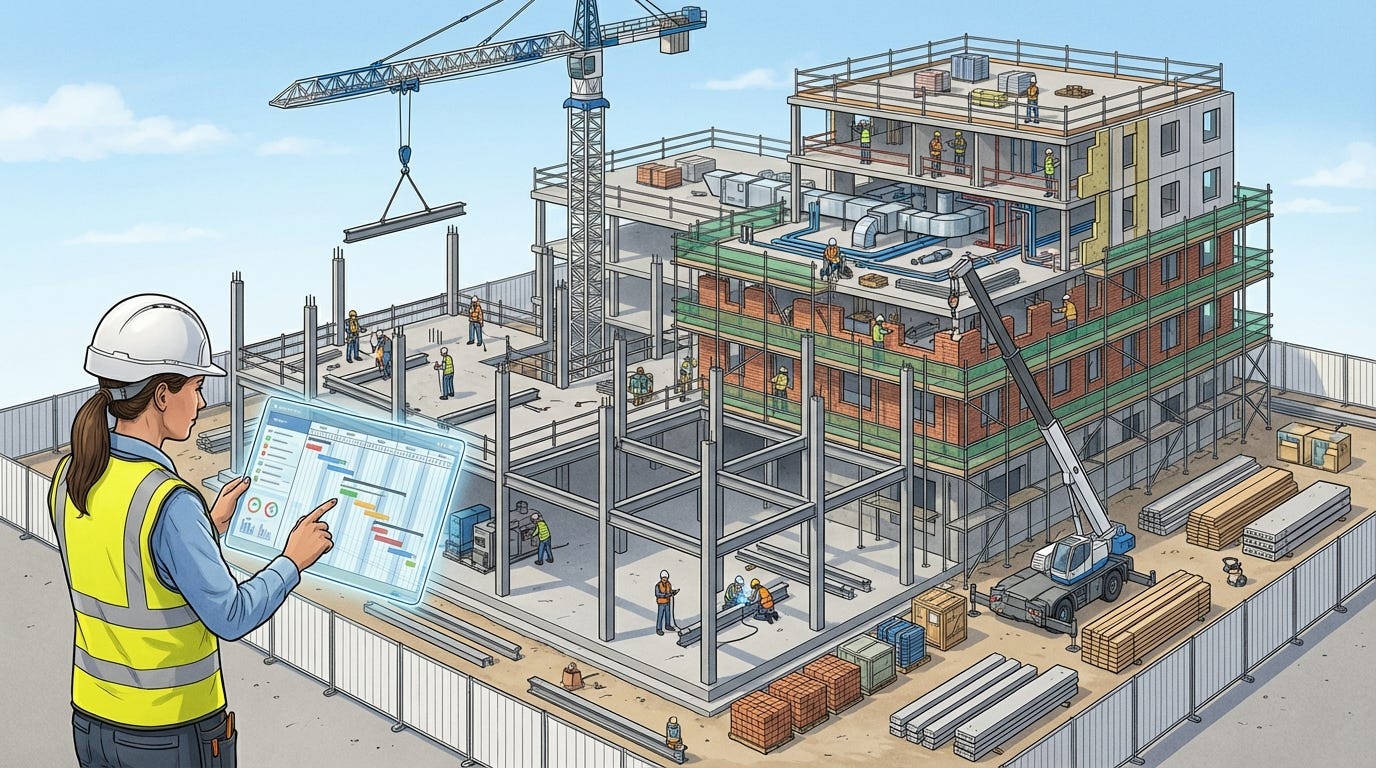
Project planning and control are fundamental elements in ensuring the successful delivery of construction projects. Ineffective planning and weak control mechanisms often result in schedule delays, cost overruns, and compromised quality. This paper discusses a systematic approach to project planning and control within the construction industry, emphasizing the importance of clear objective setting, constraint management, structured work sequencing, and continuous performance monitoring. The discussion highlights practical methods that support effective decision-making and improve overall project performance throughout the project life cycle.
The construction industry is characterized by its complexity, dynamic environment, and high level of uncertainty. Construction projects typically involve multiple stakeholders, limited resources, strict timelines, and significant financial commitments. In such conditions, effective project management becomes essential to ensure that project objectives are achieved. Among the core components of project management, planning and control play a critical role in guiding project execution and maintaining alignment with predefined goals. A systematic approach to these processes enhances coordination, reduces risks, and improves the predictability of project outcomes.
Project Planning Concepts
Project planning represents the foundation upon which successful project execution is built. It involves defining project objectives related to scope, time, cost, and quality. Clearly defined objectives provide direction to the project team and establish performance benchmarks against which progress can be measured. Without clear objectives, project activities may become fragmented and inefficient. In addition to objective setting, effective planning requires early identification of project constraints. These constraints may include budget limitations, availability of labour and equipment, site conditions, and regulatory requirements. Recognizing such constraints at the planning stage allows realistic strategies to be developed and reduces the likelihood of major disruptions during execution. Planning also requires organizing project activities into logical phases that reflect the natural sequence of construction work.
Work Structuring and Scheduling
A structured breakdown of construction activities is essential for effective project planning. Dividing the project into manageable components allows for better coordination, resource allocation, and progress tracking. Typical construction phases include foundation works, structural construction, roofing, internal finishes, mechanical and electrical installations, and final completion works. Scheduling translates these activities into a time-based framework that defines the sequence and duration of each task. An effective schedule helps identify critical activities that directly affect project completion. It also enables project managers to anticipate potential delays and take preventive actions. Through proper scheduling, dependencies between activities can be managed efficiently, minimizing conflicts and idle resources.
Project Control and Performance Monitoring
Project control focuses on monitoring actual performance against planned targets. It involves regular assessment of progress, cost expenditure, and schedule compliance. Continuous monitoring allows deviations to be identified at an early stage, preventing minor issues from escalating into major project failures. Corrective actions may include rescheduling activities, reallocating resources, or adjusting work methods to improve productivity. Project control is not intended to penalize underperformance but rather to support informed decision-making. Effective control mechanisms also strengthen communication between management teams and site personnel, ensuring that project objectives remain clearly understood and consistently pursued.
Integration of Planning and Control
Planning and control are interdependent processes that operate in a continuous cycle. Planning establishes the baseline for execution, while control provides feedback on actual performance. This feedback enables the project team to refine plans, respond to changes, and adapt strategies as conditions evolve. The integration of planning and control enhances project flexibility without compromising discipline and accountability. Such an approach is particularly valuable in construction projects, where unforeseen challenges frequently arise.
In conclusion, systematic project planning and control are critical success factors in construction project management. By establishing clear objectives, recognizing constraints, structuring work logically, and monitoring performance continuously, project teams can significantly improve efficiency and reduce project risks. The integration of planning and control supports proactive management and enables projects to be delivered within the required time, cost, and quality parameters. This approach provides a practical framework that can be applied across various types of construction projects to enhance overall project performance.
Author: PMr. Br. Shahrul Aswad bin Shahrul Amir