


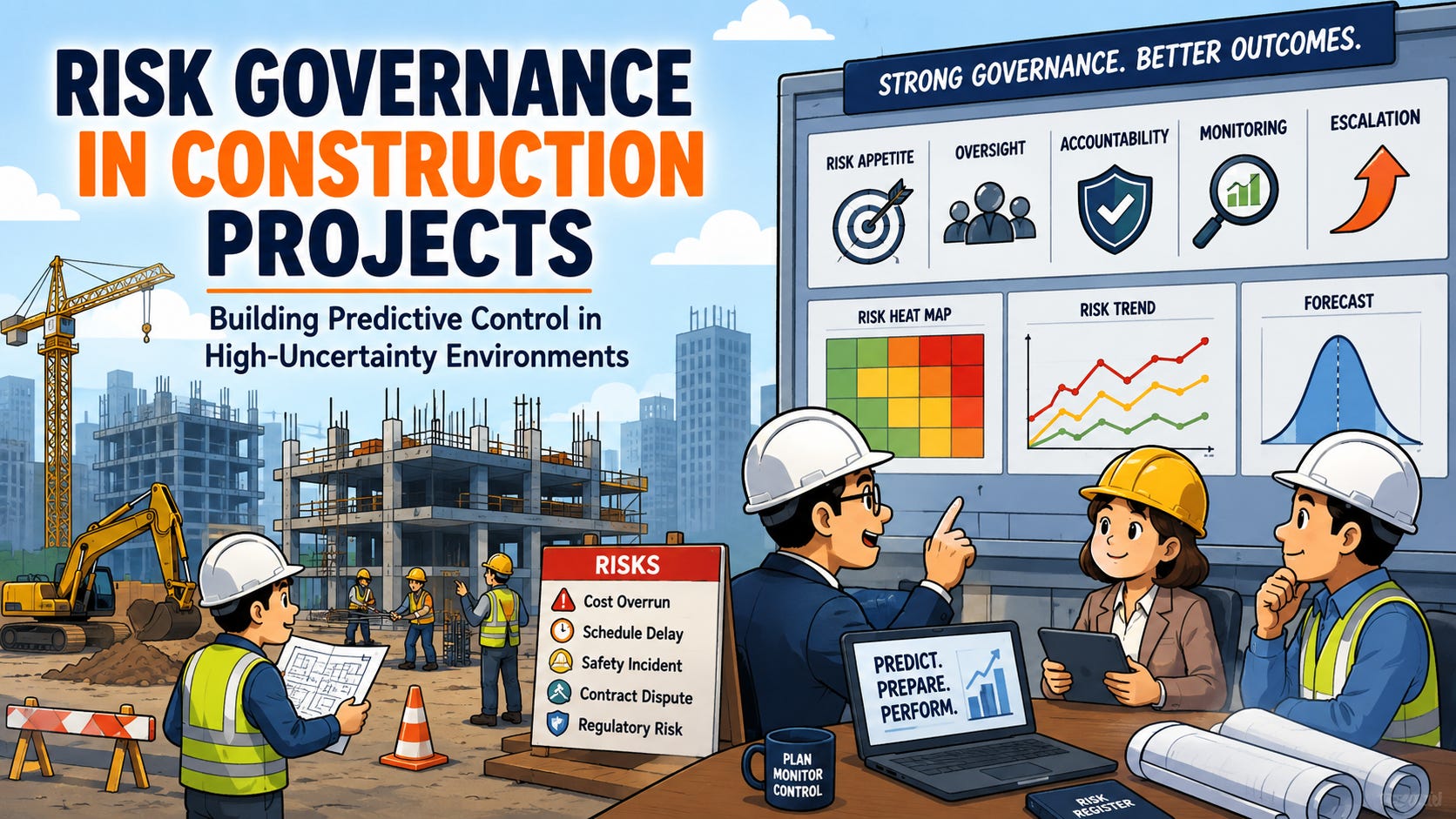
Construction has never been a low-risk industry.
Every project operates within a web of uncertainty—design changes, material price fluctuations, labour shortages, safety concerns, regulatory requirements, cash flow pressures, stakeholder conflicts, and countless unforeseen events. The larger the project, the greater the potential impact when risks are poorly managed.
Yet despite decades of progress in project management methodologies, cost overruns, delays, disputes, and project failures remain common across the industry.
The reason is simple: many organisations still treat risk as a management issue when it is fundamentally a governance issue.
Managing risks is important. Governing risks is what determines whether an organisation can consistently deliver successful projects.
The Difference Between Risk Management and Risk Governance
Most construction professionals are familiar with risk management.
Risk registers are created. Risks are identified. Probability and impact scores are assigned. Mitigation actions are discussed during project meetings.
However, risk governance goes much further.
Risk governance focuses on the systems, structures, and accountability mechanisms that ensure risks are continuously monitored, escalated, reviewed, and acted upon throughout the life of a project.
In simple terms:
Risk management asks: “What should we do about this risk?”
Risk governance asks: “Who is accountable, when should action be taken, and how do we ensure decisions are made before the risk becomes a crisis?”
Without governance, risk management often becomes a paperwork exercise.
Risk registers get updated, but critical decisions are delayed.
Warning signs are identified, but nobody owns the response.
Risks become visible only after they have already materialised.
Why Construction Projects Are Especially Vulnerable
Construction projects operate in environments characterised by complexity and interdependence.
A delay in procurement affects site activities.
A design issue impacts cost.
A cash flow problem affects subcontractor performance.
A regulatory non-compliance issue can halt an entire project.
Because construction projects involve multiple parties working simultaneously toward a common objective, risks rarely exist in isolation. They cascade across the project ecosystem.
Research on major infrastructure projects consistently shows that underestimated risks and optimism bias are among the leading causes of cost overruns and schedule delays.
The challenge is not simply identifying risks.
The challenge is creating governance structures capable of responding before those risks escalate.
The Malaysian Construction Risk Landscape
In Malaysia, risk governance carries additional importance due to the industry’s regulatory environment.
Construction organisations must navigate requirements from agencies such as:
The Construction Industry Development Board (CIDB)
The Board of Engineers Malaysia (BEM)
The Malaysian Anti-Corruption Commission (MACC)
Non-compliance can result in financial penalties, project suspension, reputational damage, and legal consequences.
At the same time, contractual disputes, variation claims, and arbitration cases continue to consume significant resources across both public and private sector projects.
Effective risk governance therefore requires a holistic view that integrates:
Regulatory risks
Financial risks
Contractual risks
Operational risks
Safety risks
Strategic risks
Managing these areas separately is no longer sufficient.
Building a Risk Governance Architecture
A mature risk governance framework operates across three interconnected levels.
1. Corporate-Level Governance
Risk governance begins at the top.
Senior leadership must define the organisation’s risk appetite and establish clear boundaries around acceptable exposure.
This includes decisions regarding:
Financial exposure limits
Contingency reserves
Reporting requirements
Escalation thresholds
Oversight structures
When risk appetite is clearly defined, project teams gain clarity regarding the decisions they can make independently and those that require executive intervention.
2. Project-Level Governance
Project-level governance translates corporate expectations into operational controls.
Effective mechanisms often include:
Project risk committees
Stage-gate reviews
Escalation triggers
Contingency release approvals
One of the most valuable governance tools is the stage-gate review process.
These structured checkpoints help organisations avoid what behavioural researchers refer to as escalation of commitment—the tendency to continue investing in failing initiatives simply because significant resources have already been committed.
Strong governance creates decision points where difficult questions must be asked before additional resources are allocated.
3. Operational Governance
At the operational level, governance becomes visible through daily project controls.
The foundation remains the risk register.
However, an effective risk register is more than a list of potential problems.
Each entry should clearly identify:
Risk description
Root cause
Probability
Impact
Exposure score
Mitigation strategy
Responsible owner
Review timeline
Most importantly, every risk must have an owner.
A useful governance principle is:
No risk without ownership.
No ownership without authority.
No authority without accountability.
Without clear ownership, risks remain everybody’s concern and nobody’s responsibility.
Moving Beyond Qualitative Risk Assessments
Many organisations still rely heavily on qualitative assessments.
Risks are labelled as “high”, “medium”, or “low” and discussed during project meetings.
While useful, qualitative assessments alone are often insufficient for large or complex projects.
This is where quantitative risk analysis becomes valuable.
One widely used approach is Monte Carlo Simulation.
By modelling thousands of potential scenarios, organisations can better understand:
Cost uncertainty
Schedule variability
Contingency requirements
Probable project outcomes
Instead of asking, “Will this project finish on time?”
Leaders can ask:
“What is the probability of finishing on time?”
That shift fundamentally improves decision quality.
Risk Governance as a Claims Prevention Strategy
Many construction disputes originate from risks that were identified but not governed effectively.
Examples include:
Poorly controlled design changes
Inadequate documentation
Weak change management processes
Contractual non-compliance
Delayed decision-making
When governance mechanisms are absent, small issues often evolve into costly claims.
Conversely, organisations with strong governance structures typically experience:
Earlier issue detection
Better documentation quality
Faster escalation
Improved stakeholder alignment
Reduced dispute frequency
Risk governance is therefore not merely a compliance function.
It is one of the most effective forms of claims prevention available to project organisations.
Integrating Risk and Financial Governance
Risk and finance should never operate in separate silos.
Every significant risk has financial implications.
Risk exposure directly influences:
Cash flow projections
Contingency reserves
Margin protection
Cost forecasts
Organisations that integrate risk data with project financial systems gain a more realistic view of future project performance.
This enables proactive intervention before financial problems become visible through traditional reporting metrics.
The most advanced organisations increasingly combine risk data with Earned Value Management (EVM) to generate risk-adjusted project forecasts.
The Rise of Predictive Risk Governance
Digital transformation is changing the future of risk governance.
Traditional governance relied heavily on historical reporting.
Modern governance increasingly relies on predictive insights.
Emerging technologies now support:
AI-powered risk pattern detection
Real-time project dashboards
Digital twins
Automated early warning systems
Predictive analytics platforms
Rather than reporting what happened last month, organisations can identify emerging risk patterns before they affect project outcomes.
The goal is shifting from reactive governance to predictive governance.
A Five-Level Risk Governance Maturity Model
Organisations typically evolve through five stages of risk governance maturity:
Level 1: Ad Hoc
Risks are discussed informally with minimal documentation.
Level 2: Documented
Basic risk registers exist but ownership remains inconsistent.
Level 3: Structured
Risk ownership, review cycles, and governance procedures are established.
Level 4: Integrated
Quantitative analysis, dashboards, and financial integration are implemented.
Level 5: Predictive
AI-enabled forecasting and automated early warning systems support proactive decision-making.
The higher the maturity level, the greater the organisation’s ability to manage uncertainty while maintaining project stability.
A Practical Roadmap for Malaysian Contractors
For organisations seeking to strengthen risk governance, transformation does not need to happen overnight.
A practical roadmap might include:
Phase 1: Establish a standardised risk register.
Phase 2: Assign ownership and formal review cycles.
Phase 3: Link risk exposure to contingency governance.
Phase 4: Introduce quantitative risk analysis.
Phase 5: Implement digital dashboards.
Phase 6: Deploy predictive analytics and automated alerts.
For many mid-sized contractors, this journey can realistically be achieved within 12 to 18 months.
Final Thoughts
The future of construction will not be defined by organisations that eliminate risk.
Risk can never be eliminated.
The future belongs to organisations that govern risk effectively.
Construction project success is rarely determined by the absence of uncertainty. It is determined by the strength of the systems that detect, control, and respond to uncertainty before it becomes a crisis.
As Malaysia’s construction industry continues to embrace digitalisation, sustainability, and increasing project complexity, risk governance will become far more than a compliance requirement.
It will become a strategic competitive advantage.
The question for construction leaders is no longer whether risks exist.
The question is whether the organisation’s governance systems are mature enough to see them coming.
The articles and technical notes published on this website are intended for knowledge sharing and professional discourse within the construction project management community. The views, opinions, and interpretations expressed are those of the respective authors and do not necessarily reflect the official policy, position, or constitutional stance of the Association of Construction Project Managers Malaysia (ACPM) or its Council.
The content should not be construed as legal, regulatory, or professional advice. Readers are encouraged to exercise their own professional judgement and seek appropriate advice where necessary.