


Sustainability has become one of the defining priorities across Malaysia’s construction and property sectors. Organisations are increasingly investing in renewable energy systems, electric vehicles, and other green technologies as part of their Environmental, Social and Governance (ESG) commitments.
While these initiatives are commendable, there is an important engineering principle that is often overlooked.
Many organisations unintentionally prioritise renewable energy investments before addressing opportunities to improve the efficiency of their existing buildings and systems. From an engineering perspective, this sequence can significantly reduce the overall return on investment while limiting the intended environmental benefits.
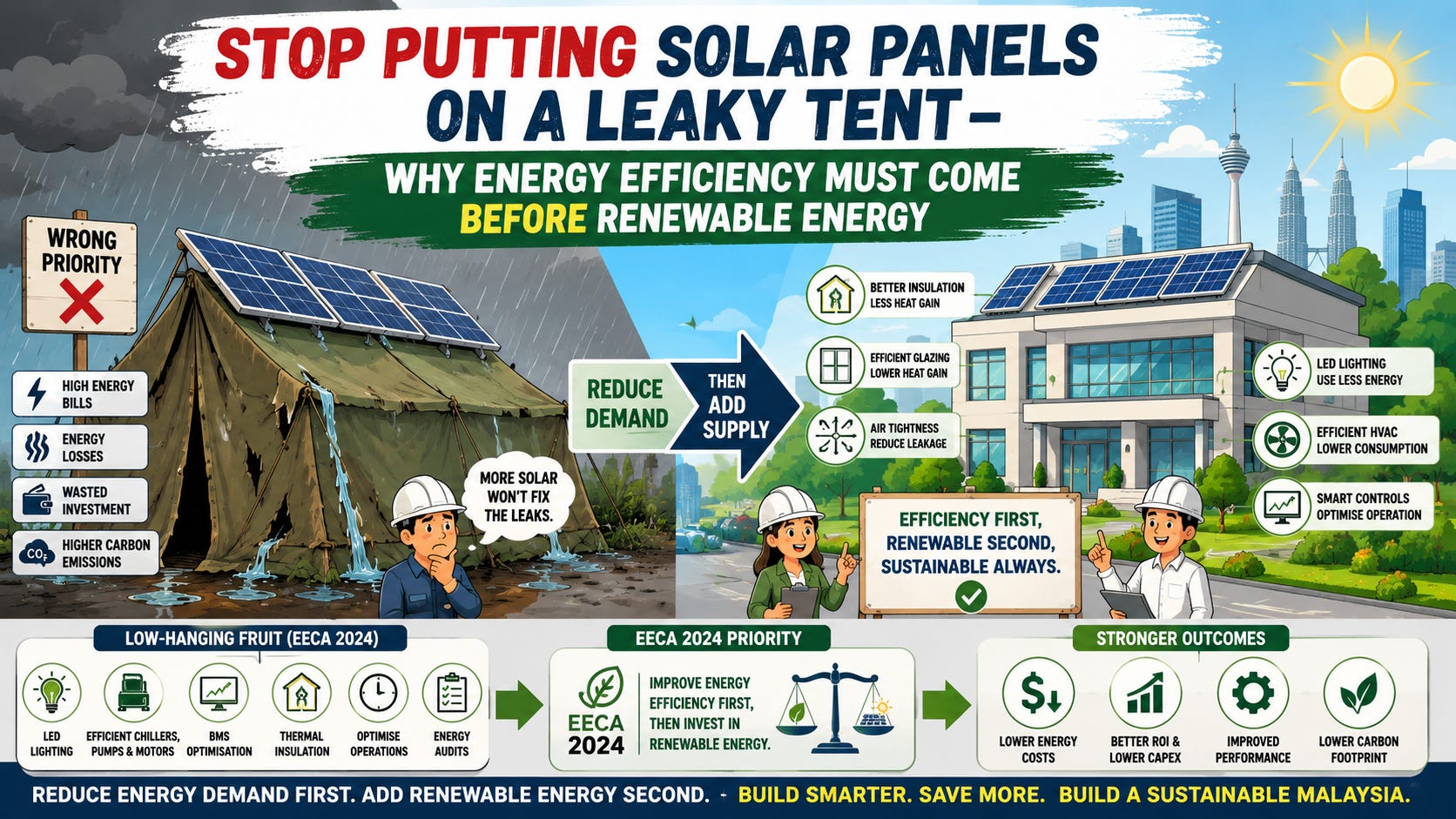
A simple analogy illustrates the issue well. Imagine trying to fill a leaking tank with clean water. Instead of repairing the leaks, more effort is spent installing a larger and more sophisticated water supply. Although the source of water may be improved, the losses remain unchanged.
The same principle applies to buildings.
Before investing in renewable energy, it is essential to first minimise unnecessary energy consumption.
Understanding the Difference
Although Energy Efficiency (EE) and Renewable Energy (RE) are often discussed together, they address two very different objectives.
Renewable Energy focuses on where electricity is generated. It replaces conventional fossil-fuel-based electricity with cleaner sources such as solar, hydro or wind.
Energy Efficiency, on the other hand, focuses on how much energy is required to achieve the same outcome. It aims to eliminate unnecessary energy consumption through better design, improved equipment selection and smarter operation of buildings.
Both are essential components of sustainable development. However, engineering best practice has always recognised that reducing demand should precede increasing supply.
This philosophy is also reflected in Malaysia’s Energy Efficiency and Conservation Act (EECA) 2024, which encourages organisations to identify and implement practical energy-saving measures before considering larger renewable energy investments.
A Simple Example: Lighting Upgrade
Consider a typical office corridor still fitted with an ageing 36-watt fluorescent lamp.
One approach is to maintain the existing lighting system while installing rooftop solar panels to generate the electricity required to power it.
A more effective engineering solution is to replace the fluorescent fitting with a modern 13-watt LED luminaire.
The illumination level remains comparable, maintenance requirements are reduced, and electricity consumption immediately decreases by approximately two-thirds.
Without generating a single kilowatt of renewable energy, significant savings have already been achieved simply by improving efficiency.
This demonstrates one of the most fundamental principles of sustainable engineering—the cleanest unit of energy is often the one that never needs to be consumed.
Building Performance Before Solar Investment
The same principle becomes even more significant when applied to building cooling systems.
It is not uncommon for building owners to propose large rooftop photovoltaic systems to offset rising air-conditioning costs. However, an engineering assessment often reveals that the building itself is operating inefficiently.
Common observations include:
Poor thermal insulation within the roof.
Inefficient glazing or single-pane windows.
Air leakage through poorly sealed openings.
High solar heat gain through the building envelope.
Under these conditions, air-conditioning systems work significantly harder than necessary because valuable cooled air escapes while external heat continuously enters the building.
Installing solar panels in such circumstances simply supplies cleaner electricity to an inefficient building.
A more sustainable strategy is to first improve the building envelope by reducing heat gain and minimising cooling losses. Better insulation, improved glazing, proper sealing and passive design measures can substantially reduce cooling demand.
Only then should renewable energy systems be sized to support the building’s actual energy requirements.
This integrated approach delivers stronger environmental outcomes while significantly improving life-cycle cost performance.
The Engineering Priority Under EECA 2024
The introduction of the Energy Efficiency and Conservation Act (EECA) 2024 reinforces an important shift in industry thinking.
The legislation encourages organisations to prioritise practical energy efficiency improvements before investing in renewable energy generation.
Examples of these “low-hanging fruit” include:
Replacing conventional lighting with high-efficiency LED systems.
Upgrading ageing chillers, pumps and motors.
Improving Building Management System (BMS) controls.
Enhancing thermal insulation and building envelope performance.
Optimising operational schedules and equipment utilisation.
Conducting professional energy audits to identify avoidable losses.
These measures are generally more cost-effective, easier to implement and capable of delivering immediate reductions in energy consumption.
Once demand has been minimised, renewable energy systems can then be designed more efficiently, often requiring lower installation capacity and reduced capital expenditure.
Integrating Efficiency into Project Delivery
For project managers, designers and asset owners, energy efficiency should not be treated as a standalone sustainability initiative.
Instead, it should become an integral consideration throughout the project lifecycle—from planning and design through construction, commissioning and facility operation.
Early engineering decisions relating to building orientation, façade performance, equipment selection and operational strategies frequently deliver greater long-term value than relying solely on renewable energy technologies after project completion.
The objective is not simply to produce cleaner energy, but to reduce unnecessary demand in the first place.
Conclusion
Renewable energy remains an essential part of Malaysia’s journey towards a lower-carbon future. However, renewable energy should complement efficient buildings—not compensate for inefficient ones.
Before investing in solar panels or other renewable technologies, organisations should first evaluate how efficiently their buildings already perform.
Simple improvements such as upgrading lighting, strengthening thermal insulation, optimising mechanical systems and conducting professional energy audits often provide the fastest and most economical pathway towards lower energy consumption.
In engineering, the most sustainable building is not necessarily the one that generates the most renewable energy. It is the one that requires the least energy to operate while consistently delivering the required level of performance.
By reducing energy demand first and introducing renewable energy second, organisations will achieve stronger financial returns, improved operational efficiency and more meaningful environmental outcomes—precisely the direction envisioned under Malaysia’s Energy Efficiency and Conservation Act 2024.
By PMr. Ir. Zaki Kudus
The articles and technical notes published on this website are intended for knowledge sharing and professional discourse within the construction project management community. The views, opinions, and interpretations expressed are those of the respective authors and do not necessarily reflect the official policy, position, or constitutional stance of the Association of Construction Project Managers Malaysia (ACPM) or its Council.
The content should not be construed as legal, regulatory, or professional advice. Readers are encouraged to exercise their own professional judgement and seek appropriate advice where necessary.