


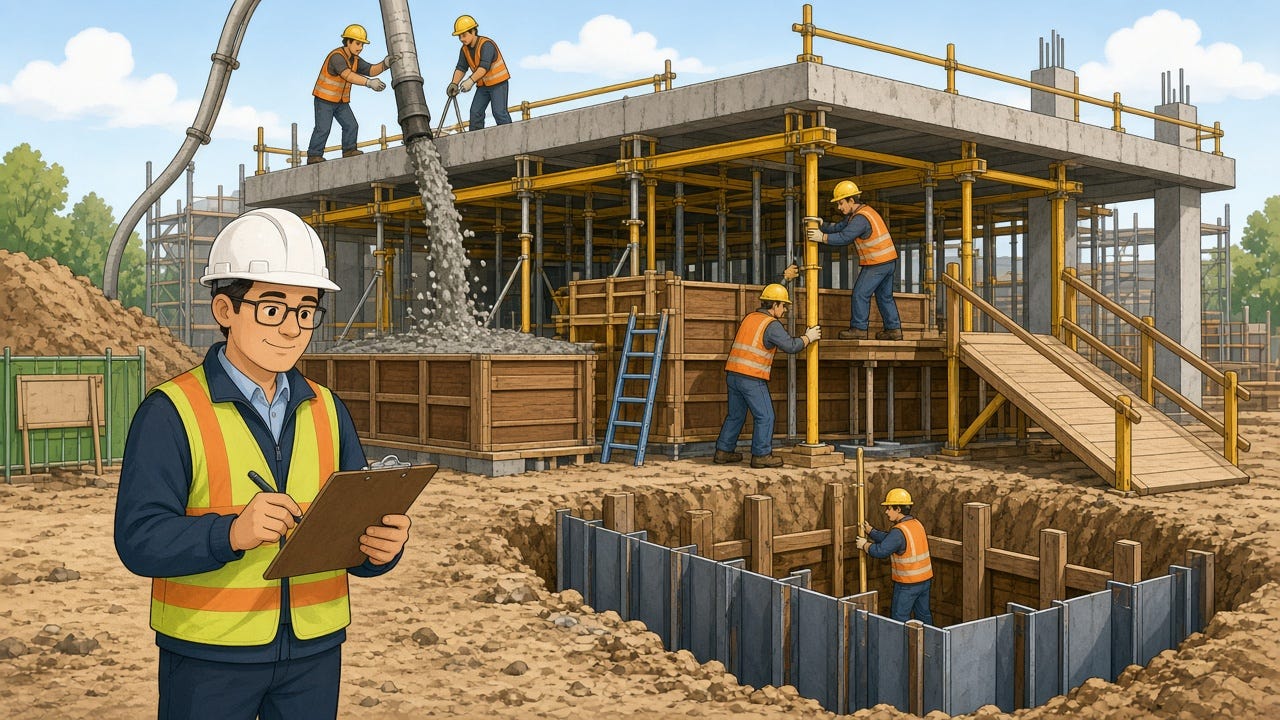
Walk onto a typical Malaysian high-rise or infrastructure site at dawn and the eye goes first to the permanent works: the floor plate rising, the pier stem, the bridge deck. Less noticed is the structure that makes those things possible — the falsework towers, the formwork shutters, the sheet piles holding an excavation open beside a busy road, the temporary traffic diversion that keeps the public safe while a package advances. Temporary works are the invisible structure of every project. They seldom own a clear line on the master programme. They rarely get the same governance attention as the permanent design. And yet, when they are late, under-designed, poorly inspected or struck too early, the permanent works stop — and so does everything that depends on them.
This article is not a temporary-works engineering manual. It is a project-management case for treating temporary works as a managed deliverable: owned, briefed, checked, programmed, inspected and changed under control — just like any other critical package on a PAM, PWD or multi-contractor site.
What temporary works actually cover
On Malaysian projects the phrase “temporary works” is often used narrowly for formwork and falsework. In practice the envelope is wider. It typically includes:
Formwork and falsework — shutters, falsework towers, flying forms, table forms and the striking sequence that releases them for the next pour.
Excavation support — sheet piles, soldier piles and lagging, strutting, anchors and dewatering arrangements that keep a basement or cut open and stable.
Access and working platforms — scaffolding, mast climbers, temporary stairs, loading bays and edge protection that let people and materials move safely.
Lifting and temporary stability — crane bases, outrigger pads, temporary bracing of steel frames, and props that hold elements until the permanent structure can take the load.
Site logistics that behave like works — temporary roads, haul routes, stockpile platforms, and temporary traffic schemes where the public interface meets the construction zone.
Weather and monsoon adaptations — temporary drainage, bunds, covers and flood-path management that become essential during the wet season.
If it is needed for construction, will later be removed or altered, and can harm people, programme or the permanent works if it fails, it belongs in the temporary-works conversation.
Why the project manager must own the outcomes
Temporary works are often left to a specialist designer, a formwork supplier, or the site agent of a package contractor. That division of labour is sensible for the technical design. It is not enough for project outcomes.
The project manager sits at the only place where the interfaces meet: permanent design changes that alter load paths; a delayed basement dig that extends the life of an excavation support system; a craneage clash between packages; a client instruction that rearranges the pour sequence; an authority condition on a temporary traffic scheme. None of those issues lives neatly inside one engineering silo. When temporary works are treated as “someone else’s detail,” the PM discovers the gap only when a hold point fails or a package cannot start.
Under Malaysian project environments — whether private-sector PAM forms, public PWD/JKR arrangements, or CIDB-registered multi-contractor sites — the PM is also the person who must keep programme, commercial exposure and safety governance aligned. Temporary works sit across all three. A falsework system that cannot be struck because curing times were never modelled on the programme is not only a site problem; it is a commercial and reputational one.
Competence still matters. Temporary works need appropriately qualified designers and checkers. The PM’s role is not to replace them. It is to appoint, brief, gate and integrate so that their work lands in time, in sequence, and under clear hold points.
A practical control framework
A workable temporary-works control framework for a Malaysian PM does not require a new bureaucracy. It needs a few disciplined gates.
1. Appointment and competence. Decide early who designs, who checks, who installs, and who inspects. For higher-risk systems — deep excavation support, heavy falsework, temporary works that affect the public — require evidence of competence and experience with similar systems, not just a general PE stamp. Clarify whether the temporary-works designer is engaged by the main contractor, a specialist, or the employer, and how that sits with the permanent-works consultants.
2. Design brief. Temporary works fail as often from a wrong brief as from a wrong calculation. Capture the construction sequence, expected loads (including construction plant and stacked materials), ground conditions, adjacent structures, authority constraints, monsoon considerations, and the intended life of the system. If the permanent design is still evolving, say so — and define how design development will be fed back into the temporary-works brief.
3. Design and independent check where warranted. Not every scaffold needs an independent Category 3-style check. Higher-consequence systems do deserve a proportionate independent review, in the spirit of temporary works coordination practice long established in the UK and Commonwealth tradition: design, check, and a clear person accountable for coordinating temporary works across the site. Adopt the principle even if your contract does not name the role.
4. Method statements and installation quality. The approved drawing is not the installed system. Method statements should cover erection sequence, tolerances, inspection during installation, and what to do when site conditions differ from the design assumptions. On multi-contractor sites, insist that interfaces — shared falsework, shared excavation support, shared access — are written into the method, not left to informal agreement.
5. Hold points and permit-to-load. Before a system takes its design load — first pour on a new formwork setup, first dig behind a strutted wall, first use of a temporary platform — require a documented inspection and a clear permit-to-load (or equivalent). This is the moment where rushed programmes most often cut corners. Protect the hold point in the programme so that “we need to pour tomorrow” cannot quietly erase it.
6. Inspection in use and change control. Temporary works live in a changing site. Materials get stacked where the design did not allow; a sequence change brings a heavier crane onto a temporary road; monsoon flooding alters ground conditions around an excavation. Build in routine inspection and a simple change-control rule: if the sequence, load or environment changes, the temporary-works design and permits are reviewed before work continues.
Programme and commercial hooks
Temporary works earn their place on the master programme when PMs stop treating them as free float.
Access and craneage depend on temporary roads, pads and platforms. If those are late, every package that assumed them is late.
Striking and reuse cycles for formwork and falsework often govern floor-cycle times on high-rise frames. Model curing, striking and flying-form moves as real activities, not invisible gaps.
Excavation support duration has commercial consequences: longer open excavations mean longer dewatering, longer traffic diversions, and sometimes redesign if ground behaviour differs from assumptions.
Monsoon and wet-season risk can turn temporary drainage and slope protection from “nice to have” into critical path items. Plan them before the rains, not during them.
Delayed permanent works extend the life of temporary systems. If a permanent slab that was meant to replace temporary propping slips by weeks, check whether the temporary system was designed — and commercially allowed — for that longer life.
Commercially, unclear temporary-works scope is a classic source of friction between packages: who pays for shared falsework, who redesigns when the sequence changes, who owns the temporary traffic scheme conditions. Settling those questions in the procurement and coordination stage is cheaper than arguing them after a stoppage.
International practice, local application
The UK and wider Commonwealth tradition of temporary works coordination — with designated coordination roles, categorised design checking, and permit-to-load discipline — grew from hard lessons about what happens when temporary systems are treated as informal site craft rather than engineered works. Similar principles appear, under different names, on major infrastructure programmes internationally: clear ownership, design gates, inspection before loading, and integration with the construction sequence.
Malaysian project managers do not need to import a foreign bureaucracy wholesale. They do need the intent: temporary works are engineered, coordinated and held to gates. That intent fits cleanly inside existing PAM/PWD project controls, CIDB safety expectations, and the multi-package reality of local high-rise and infrastructure sites. The local flavour is monsoon planning, authority interfaces on temporary traffic and public protection, and the practical competence market for specialist temporary-works designers and checkers.
A short checklist for project managers
Name temporary works as a managed deliverable in the project execution plan, with an accountable owner.
Brief designers on sequence, loads, ground, adjacent assets, authority constraints and monsoon life.
Match check intensity to consequence; protect independent review for higher-risk systems.
Put erection, inspection, permit-to-load and striking on the programme as real activities.
Lock hold points so programme pressure cannot silently remove them.
Control changes to sequence or load; re-validate temporary works before continuing.
Align package interfaces for shared systems and temporary traffic schemes early.
Inspect in use — especially after weather events, plant moves or stacked-material changes.
Tie temporary-works duration to commercial exposure when permanent works slip.
Close out removal and making-good as deliberately as installation.
Temporary works will remain partly invisible on every site photograph. They should not remain invisible on the project manager’s risk register, programme or meeting agenda. Treat them as structure — temporary, yes, but structure all the same — and they will support the permanent works as intended. Leave them in the blind spot, and they have a way of becoming the most visible problem on the project.
The articles and technical notes published on this website are intended for knowledge sharing and professional discourse within the construction project management community. The views, opinions, and interpretations expressed are those of the respective authors and do not necessarily reflect the official policy, position, or constitutional stance of the Association of Construction Project Managers Malaysia (ACPM) or its Council.
The content should not be construed as legal, regulatory, or professional advice. Readers are encouraged to exercise their own professional judgement and seek appropriate advice where necessary