


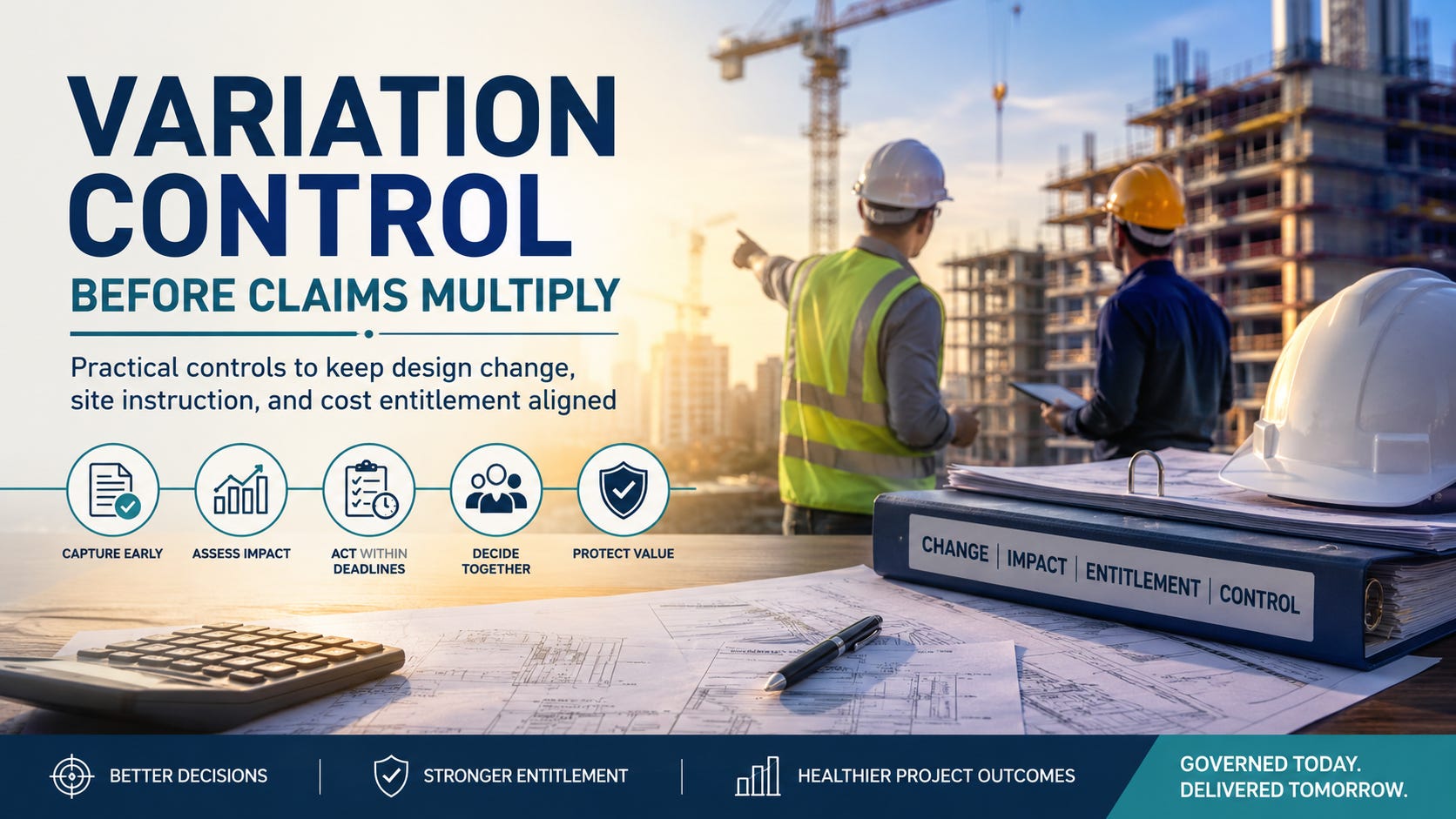
Commercial and Financial Management has become a decisive capability in modern construction because delivery speed, funding pressure, and stakeholder expectations now change faster than traditional controls. In Malaysia and across the region, project teams are expected to protect value while still moving quickly through procurement, construction, and handover. Within this environment, strong variation management is less about producing paperwork and more about improving decisions under pressure. When governance is disciplined, teams reduce rework, avoid avoidable claims, and create confidence for clients, contractors, and financiers.
From a governance perspective, teams should set a clear cadence for commercial health reviews with decision-makers present, not only report preparers. The review should test assumption quality, contract exposure, and near-term cash impact in the same conversation. When this discipline is sustained, variation management becomes a leadership habit across the project rather than a specialist activity left to month-end cycles.
A practical starting point is to capture change intent early before work proceeds on verbal direction. This shifts commercial control from reactive month-end correction to proactive daily management. When the operating picture is updated continuously, leaders can see where assumptions are drifting and intervene before the drift becomes a financial shock. The most resilient teams make this visible across disciplines so planners, engineers, and quantity surveyors are working from one truth.
The next control layer is to distinguish scope growth from productivity loss and sequencing disruption. Projects often lose margin not through one large failure, but through repeated small decisions taken without full consequence mapping. Commercial managers should therefore challenge optimistic narratives early, test sensitivity, and document decision rationale. That discipline protects both governance quality and working relationships when performance pressure rises.
Forecast reliability improves when teams quantify time and cost impact using shared assumptions with planners. A forecast should not be a static spreadsheet produced for reporting; it should behave like a risk radar. Scenario planning, defined trigger levels, and clear response ownership allow the organization to adapt without panic. In complex projects, the ability to update course quickly is often a stronger advantage than having a perfect baseline on day one.
Contract administration must also become operational. Teams should issue contemporaneous notices within contract deadlines every time, then test whether those rules are actually understood at package level. Where commercial language stays abstract, execution quality drops. Where expectations are concrete and timely, entitlement and payment discussions become less adversarial. This is especially important in multi-party environments where interface ambiguity can multiply cost and delay.
Risk management is sharper when leaders maintain a single source-of-truth variation register with ownership and due dates. Early-warning systems only work when they trigger action, not just additional meetings. High-performing organizations connect these triggers to escalation paths, decision rights, and deadlines. That operational clarity keeps the project moving even when external volatility—regulatory, legal, or market-based—creates uncertainty.
Execution quality depends on people and routines. It helps to use weekly change boards for fast decision cycles with client representatives so that commercial intent is reflected in daily site behavior. Many overruns begin as coordination gaps between teams that each believe they are acting correctly. Shared forums, short decision cycles, and transparent accountabilities reduce those gaps and improve confidence across the supply chain.
Technology can accelerate performance when teams archive evidence packets including drawings, photos, records, and correspondence. Digital tools should reduce friction in evidence capture, forecasting, and approvals, rather than produce extra administrative burden. The real value appears when data is trusted and decisions are traceable. In commercial leadership, speed plus auditability is a powerful combination.
For ACPM members and industry practitioners, the key message is to convert change from a conflict source into a governed commercial process. Strong commercial management is not separate from project success; it is one of its foundations. As projects become larger and interfaces become denser, organizations that institutionalize these practices will consistently deliver better outcomes. The profession’s opportunity in 2026 and beyond is to raise standards through repeatable playbooks, better training, and disciplined governance culture.
The articles and technical notes published on this website are intended for knowledge sharing and professional discourse within the construction project management community. The views, opinions, and interpretations expressed are those of the respective authors and do not necessarily reflect the official policy, position, or constitutional stance of the Association of Construction Project Managers Malaysia (ACPM) or its Council.
The content should not be construed as legal, regulatory, or professional advice. Readers are encouraged to exercise their own professional judgement and seek appropriate advice where necessary
.