


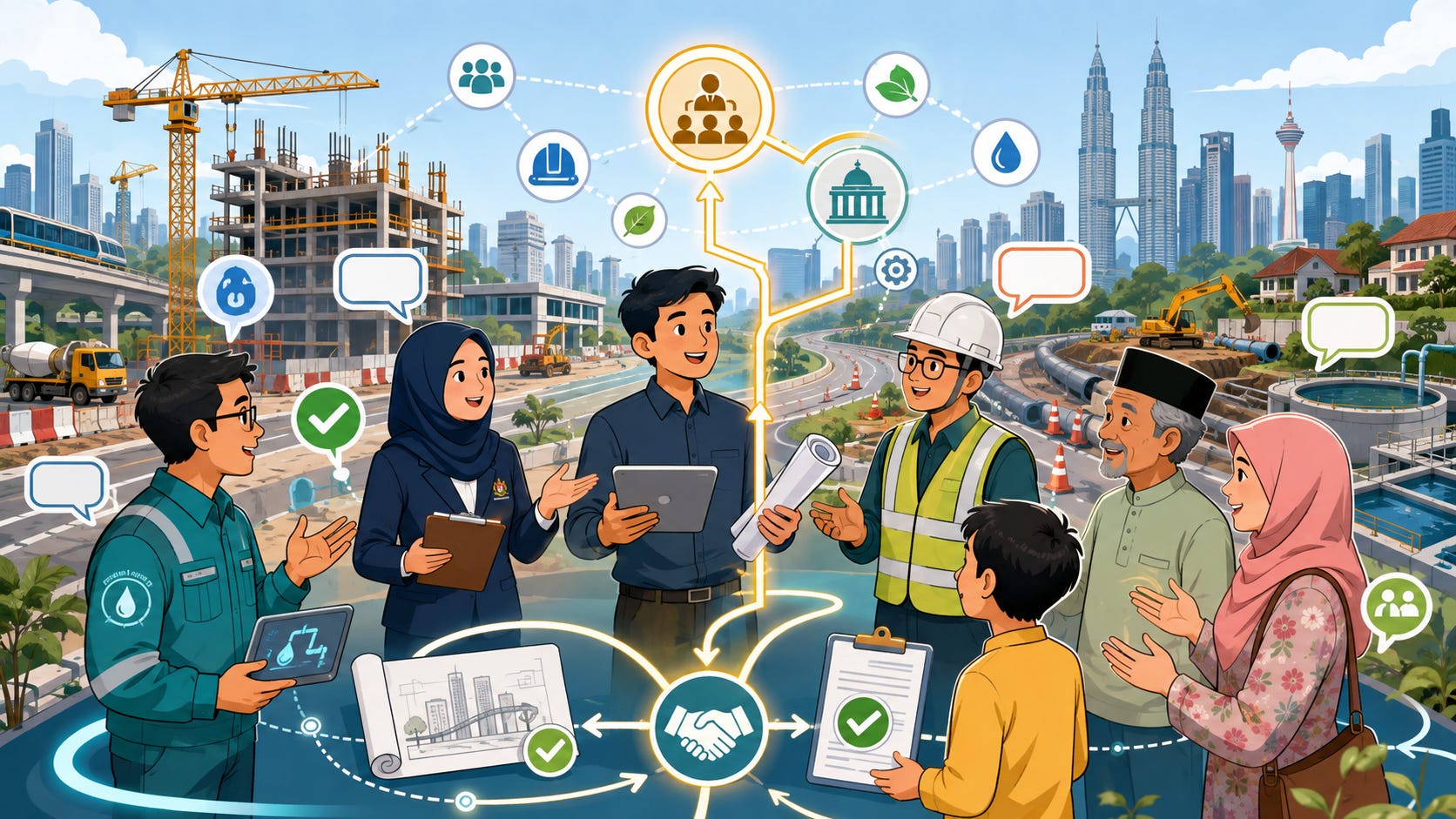
This article focuses on the critical role of stakeholder management in the Malaysian built environment, where infrastructure, utility, and government-linked projects operate within complex, multi-agency ecosystems. Historically, Malaysia’s infrastructure, utility, and government-linked projects were marked by such complexity, with project execution largely technical in nature. The study contends that a major cause of delays and inefficiencies is the lack of stakeholder management. According to the PMBOK® Guide, 7th Edition (PMI, 2021), stakeholder management is an important knowledge area of project management concerned with relationships, influence, and alignment.
The article firstly highlights the importance of understanding authority structures, particularly the concept of “punca kuasa”, in navigating overlapping jurisdictions among utility providers, regulatory bodies, and local authorities. It underscores the need for systematic stakeholder identification, sustained engagement, and recognition of social impact management (commonly known as corporate social responsibilities) as vital in building trust and securing support.
It also refers to prioritising power hierarchies and the “punca kuasa” concept to overcome jurisdictional overlaps among entities such as utility companies, regulatory bodies, and local authorities. Beyond this, it stresses a systematic approach to stakeholder identification, keeping stakeholders engaged throughout, and leveraging social impact management (SIM) to build trust and foster cooperation.
Without proper documentation, connections between stakeholders may remain vague, and these “grey” areas can significantly affect how conflicts of interest are interpreted. Ignoring or dismissing such scenarios risks a gradual breakdown of public trust in transparency, which lies at the heart of a project’s integrity. Overall, this article highlights the importance of stakeholder alignment to project success and argues that it is the leader’s responsibility to act ethically and engage stakeholders in ways that lead to sustainable outcomes, even amid increasing complexity.
Infrastructure, utilities, housing, and commercial developments are some of the sectors that underpin the built environment, and projects in these sectors are generally considered technical in nature. Discussions among professionals mostly revolve around engineering designs, meeting schedules, cost considerations, and regulatory compliance. Experienced professionals point out that, on very few occasions, project problems are purely a result of insufficient technical competence; rather, they often stem from the inability of multiple stakeholders to align and reach agreement.
Successful project delivery therefore requires more than technical expertise. It also involves the ability to identify the interrelationship within the stakeholder system, accommodate diverse interests, and align different stakeholders towards a common purpose. In this context, project management is both a science and an art.
Stakeholder Management as a Core Project Discipline
Recognising the growing complexity of project environments, the Project Management Institute (PMI) identified stakeholder management as a crucial knowledge area of project management in the PMBOK® Guide, 7th Edition (PMI, 2021). This shows a major difference from previous ways of thinking, in which stakeholder functions were mainly seen as communication tasks. The focus now lies on the fact that effective project delivery depends on building relationships, managing expectations, and influencing outcomes throughout the project lifecycle.
A robust stakeholder strategy requires structured engagement across project phases, clear and consistent communication tailored to stakeholder needs, and meaningful social impact initiatives, especially for projects with public interfaces. These elements must work together so that stakeholders are not only informed but genuinely aligned with the project’s objectives and direction.
Understanding Authority Structures: The Role of “Punca Kuasa”
One of the major issues with infrastructure and government-linked projects is identifying the real “source of approving authority” or “punca kuasa”. Officially, structural charts depict scopes of work, but most of the time, actual decision-makers are concealed within the web of complex, sometimes informal, ties.
Projects involving several agencies and utility providers, such as Tenaga Nasional Berhad (TNB), Telekom Malaysia (TM), Jabatan Kerja Raya (JKR), and local councils, are often carried out in areas where their jurisdictions overlap. Such situations may lead to conflicting instructions, waiting for approval even when the work complies with regulations, and redoing work due to changes in requirements.
Utility coordination is one of those situations where an agency’s approval does not always lead to execution, since the agency may depend on another authority, for example. Here, the lack of clearly defined decision ownership is the main cause of the standstill. According to PMBOK (PMI, 2021), stakeholders can influence or be impacted by a project. Therefore, project leaders need to determine who has the power to make decisions, when those decisions are made, and, most importantly, how that power is used.
Stakeholder Identification and Categorisation
Effective stakeholder management begins with systematic identification and analysis. The PMBOK (PMI, 2021) emphasises evaluating stakeholders based on their influence, interest, and impact. In the built environment, stakeholders usually include the following:
Primary stakeholders include project owners, clients, developers, and approving authorities
Secondary stakeholders include consultants, contractors, and suppliers
Governmental organisations, and technical agencies, such as Department of Works (JKR), Department of Occupational Safety & Health (JKKP), and Construction Industry Development Board (CIDB), are examples of institutional stakeholders.
External stakeholders include communities, public interest groups, end users, media, etc.
Stakeholder dynamics change throughout a project, with priorities and influences shifting and new stakeholders appearing. Therefore, stakeholder mapping must be viewed as an ongoing, flexible process.
Engagement and Social Considerations
Engagement is mostly performed as a compliance-type exercise, especially in common scenarios. If you are working in complex project settings, then such an approach will not suffice. PMBOK (PMI, 2021) explains that the goal of stakeholder management is to gain more support for a project while simultaneously reducing constraints. This can be achieved by continuously involving stakeholders in planning and design, communicating effectively with them, and promptly addressing their concerns.
The project’s local councils and other project stakeholders should be kept abreast of and engaged, especially if it concerns communities and public infrastructure. An effectively implemented social impact program at the community level can lead to greater acceptance and improved rapport. The aim is not merely to interact with people but to establish a long-term alignment and regularly enhance trust.
Managing Ethical Grey Areas and Conflict of Interest
In complicated project scenarios involving multiple stakeholders, not every issue is formal or apparent. Aside from conflicts of interest and differences in objectives, the project teams may also find that informal ways of doing things in the ‘ethical grey zones’, which are therefore not open to the public, may operate. It is even possible that, while such practices may remain questionable from a governance perspective, they become normalised for a period of time.
At times, such informal practices could be equated with relationship building, such as offering someone preferential treatment in approvals, providing informal incentives considered goodwill, or granting exclusive access to information and decision makers. Even if such acts do not fall under the category of explicit misconduct in a strict sense, they cause actual or perceived conflicts of interest, and preferential treatment, especially when personal relations outweigh the actual objectives in every project activity.
In multi-agency environments that include regulatory bodies, utility providers, contractors, and consultants, such ambiguous areas might even change decision-makers’ behaviour over time. What happens is that, on the surface, giving occasional permission to make minor changes results in the establishment of a kind of systematic bias, loss of openness, and weakening of the credibility of the project. Agencies like the Malaysian Anti-Corruption Commission (SPRM) do, by their rules, stress the importance of doing the right thing and being responsible. In addition, PMBOK (PMI, 2021) notes that projects are carried out in the context of larger organisational and political environments, where stakeholders’ influence can change outcomes in both formal and informal ways.
Project managers often struggle to meet the project’s technical requirements and navigate ethical grey areas without compromising their morals. More specifically, this means establishing ethical boundaries, ensuring transparent decision-making for everyone, and building a culture of professional integrity. Ethical stakeholder engagement is not about severing ties but about continuously sustaining them based on integrity.
A Practical Reflection and Conclusion
Often, major projects are derailed, not because of any technical problems, but because of disagreements among stakeholders. For example, a project was technically ready but remained idle for a long time due to ambiguity in jurisdictional issues among the agencies. Each stakeholder was doing their part, and no single agency made the final decisions. A project cannot move forward if there are no clearly defined “punca kuasa” or agreed-upon objectives by all parties.
Therefore, the major point is that technical readiness is just one factor in a project’s success; stakeholder support also matters. In today’s rapidly changing project environment, stakeholder management is the primary project delivery skill that needs to be developed. It is a move away from sorting deliverables to figuring out relationships and influence, depending less on official processes and more on knowing who really has authority, and from just responding to coordination efforts to proactively getting everybody on the same page.
Finally, whether a project succeeds is reflected in how you meet your technical goals. However, more importantly, it is the ability to bring stakeholders together within a common set of goals and responsibilities.
Author
Alwizan Mohd Ron is a certified member of the Association of Construction Project Managers (ACPM), a professional technologist (BEM and MBOT) and a project management professional (PMI, USA) with over 18 years of experience in infrastructure, building, and government-linked projects. He is currently pursuing a PhD in Management, focusing on ethical leadership and governance in state agencies. His interests include project management, stakeholder management, leadership, and public sector transformation, with a long-term aspiration to contribute to national development through leadership and public service.
Reference
Project Management Institute (PMI). (2025). A Guide to the Project Management Body of Knowledge (PMBOK® Guide) (8th ed.). PMI.
The articles and technical notes published on this website are intended for knowledge sharing and professional discourse within the construction project management community. The views, opinions, and interpretations expressed are those of the respective authors and do not necessarily reflect the official policy, position, or constitutional stance of the Association of Construction Project Managers Malaysia (ACPM) or its Council.
The content should not be construed as legal, regulatory, or professional advice. Readers are encouraged to exercise their own professional judgement and seek appropriate advice where necessary.